

[1] I was invited to ponder the following questions for this essay:
- What might be the contours of a Lutheran liturgical ethic that shapes our civic engagement?
- How do worship or prayer equip Lutherans to re-define political power?
- What roles do liturgy, prayer, and preaching play in fostering, strengthening, or supporting justice and democracy?
I have decided to merge my answers into a single essay about the sort of people our Lutheran liturgical practices might form and why this matters in the public/political sphere.
[2] The overarching point of this paper is that what we do – in worship, in our liturgy, in our communal and private prayers, in our classrooms, in our homes, in public spaces – matters. Even if and even when it feels like an uphill and pointless enterprise.
[3] I’m going to start with some of the reasons it may not feel like our – the ELCA’s — public church presence is making the difference we – those of us embedded in and perhaps even enamored of – our Lutheran inheritance imagine we should.
[4] In his Substack, “How Big is the Political Divide Between Mainline Clergy and Laity?”[1] Ryan Burge provides the following graph:
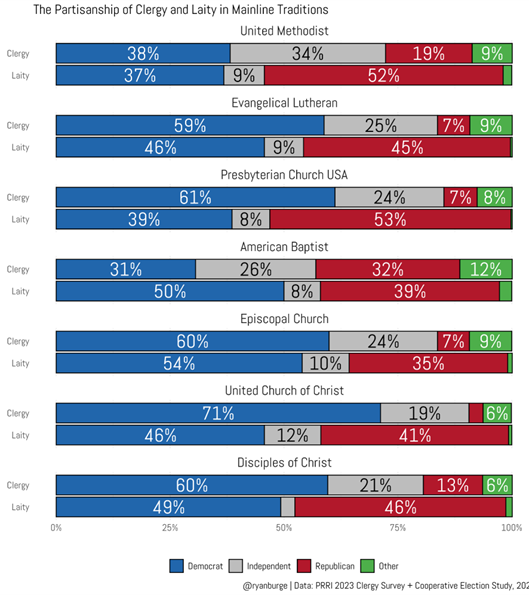
[5] When we focus attention on the ELCA line, ELCA rostered leaders (pastors and deacons) are 59% registered Democrats compared to 7% registered Republicans (with 34% being Independent or “other”). In other words, ELCA rostered leaders are 8 times more likely to be Democrats than they are Republicans. Laity who attend ELCA congregations, however, are an almost even split with 46% registered as Democrats and 45% registered as Republicans.
[6] In a contentious, divided social, cultural, and political landscape, this means the majority of ELCA pastors are serving congregations whose partisan political affiliation does not match their own. Or, to flip that, half of ELCA members attend a church where their spiritual leader’s partisan political affiliation is not their own.
[7] In addition to this, the Pew Research group has tracked educational data related to religious traditions. In the ELCA, only 39% of adult members have received a bachelor’s degree or higher.[2] At the same time – with recent changes in the Deacon roster – almost all rostered leaders in the ELCA now have an advanced degree; our clergy have disproportionately more academic education than the average adult in an ELCA congregation. This connects in nuanced ways to the data that correlates to the difference in clergy and laity partisan political preferences.
[8] In the United States the laity of the Latter-Day Saints, Roman Catholics, Evangelical Protestants, and historically Black Protestant Churches have a smaller percentage of a bachelor degree or higher than the laity of the ELCA. These denominations are predominantly politically conservative.
Seven Mountain Mandate
[9] The “seven mountain mandate” is the teaching that there are seven spheres of influence in society and the world where Christians should aim to establish God’s Kingdom here on earth.[3] These spheres are:
- Family
- Religion (or Faith)
- Education
- Media
- Arts and Entertainment
- Business (or Economics)
- Government
[10] You may be unfamiliar with the language of the seven mountain mandate, but you are, I am sure, familiar with its popular forms. Think, for instance, of Turning Point USA and Charlie Kirk. Christians who teach and preach the seven mountain mandate believe that it is OUR job as Christians to bring God’s kingdom to earth here and now. And they have the faith formation programming that makes Christian nationalism (the 7th mountain) a logical outcome. And they have clear political agendas that include support for particular partisan issues.
[11] I don’t really want us to focus on the seven mountain mandate. But I do want us to see that what we DO – and particularly how we preach (subtext, our theology) – shapes our discipleship in VERY public and political ways. And there is a significant contingent of Christian brothers and sisters whose theology – and thus their understanding of discipleship – is vastly different from the teachings of the ELCA.
[12] Importantly the folks in ELCA pews aren’t siloed… they have friends and family who worship in seven mountain mandate communities – they listen to Christian radio that is shaped by this agenda. And they may think it makes perfect sense and is the faithful, “right” way to be Christian, even if they have never heard of this seven mountain mandate.
Importance of Practices
[13] The key claim I am going to make in this essay is that we become – to some extent – what we do. So, what we do really matters. When I teach classes on faith formation I often ask who the student-athletes in my class are. I then pick a football player (I always have football players in class!) to help me. When he agrees, I ask what position he plays. This year’s conversation then went something like this:
Me: What position do you play?
Student: Offensive line.
Me: Great! Make me an offensive lineperson.
Student: (confused laughter)
Me: Seriously. I want to be an offensive lineperson and I need your help.
Student: Well, first, you’re gonna need to put on some pounds. And maybe increase your protein intake. And you’re definitely gonna need to start lifting.
Me: Great! Then I can be a football player.
Student: (laughing) Something like that.
Me: That wasn’t compelling. Help me; what do I need to do.
Student: Well, first you need to work on fast feet.
Me: I can be fast.
Student: Can I stand up? And show you.
Me: Please do!
Student: Pretend there’s a ladder here; now do this.
He shows me some fancy footwork which I copy. He seems genuinely impressed.
Student: That’s not bad.
Me: Now what.
Student: Well now you’re gonna sink down into position.
He models a stance for me; I comply.
Student: Now, run!
I run in place.
Me: Now what?
Student: You ‘bout to get hit!
Me: I want a refund. No one said anything about getting hit.
When I ask the whole class if I really became a football player, they said I lacked the size but mostly the hours – years – of good coaching and intentional practice. These are the things that had made my student a football player.
[14] Let me give another example about the importance of formation. I love birds. Had I not become a theologian, I might have been an ornithologist. In fact, apparently when I was two I wanted to be a bird when I grew up. I am fortunate, now, to be able to spend a lot of time with my two grandsons: Lucas and Hayes. Lucas is three, Hayes is 15 months. Lucas spends a lot of time with me in the garden, and he has learned to love to garden. He has also learned to love – and name – the birds we see regularly. Well before his third birthday he could identify cardinals, robins, hawks, great blue herons, crows, mockingbirds, blue jays, bluebirds, and woodpeckers. Maybe more.
[15] He was able to do this not because it is normal in the life of a 2-year-old to know birds by name, but because I adore him and he, in return, adores me and wants to spend time with me in the garden where I’ve taught him everything has a name and we should take the time to learn their names.[4]
[16] All of this is to say, by 3, Lucas was a bit of an amateur ornithologist. He was also a really good gardener and herbalist. Not because it is in his DNA, not even because it is part of his environment – though these are of course both also true – but because he chooses to spend hours with me talking about plants and bugs and herbs and birds. The more he does these things the more he embodies them
[17] Practice, coaching, formation–this is the point of worship. To embody who we already are. It is my one sentence summary of 1st Cor: You (y’all) – because Paul spoke Southern Greek – y’all are the body of Christ, darn it, act like it; be it.
[18] Because we – ELCA Lutherans – believe salvation is God’s work and God’s work alone, we aren’t trying to get people into heaven. And because we deny the theological validity of Christian nationalism and reject the notion behind the seven mountain mandate, we aren’t trying to create the Kingdom of God in the United States. That is not who we are theologically.
[19] And, think back to the political affiliation data – because we are the denomination of the deepest and most beautiful hue of purple – we pragmatically cannot tell the folks in our congregations what to think or how to vote – they are equally divided red/blue. , Further they are – overall – more highly-educated than the laity in many other churches and do not depend on their pastors to tell them what to think.
Worship as Hope-Rehearsal
[20] Lutherans do worship well; it is who we are. Orthodoxy – a word we tend to use as a way of saying we are getting our beliefs straight (we reject Docetism or Gnosticism, for example) is really about how we worship. And, of course worship is about theology – it includes the things we believe, the words we say, but it is also about a disposition, an orientation, a way of standing (or kneeling) before the Almighty God. Orthodoxy literally means “right praise”. In our orthodoxy – in our right praise, our worship, what I think we do best is practice hope.
[21] I recently read the book The Midnight Library by Matt Haig. The titular Midnight Library is something like purgatory; it is a place where not-yet-dead-but-no-longer-living souls go to explore the lives that could have been. Each book in the library is the story of the life the person would have lived if only a single different choice – big or little – had been made at any point in the “root” life.
[22] Nora Seed is the main character. When she arrives at the midnight library, the librarian is explaining how the library works to her – parallel universes, infinite possibilities. She is understandably perplexed and asks: Is this real? The librarian responds: It is real; it just isn’t reality as you know it.
[23] Worship forms us to be a people of hope by teaching us to see what is real rather than merely accepting reality as we think we know it. Let me try to unpack this… how does worship do this? And why does it matter?
[24] First, worship tells the truth about the world and refuses to despair. We begin our worship with confession; we make space for lament and intercessory prayer; we offer preaching that names the realities of sin, suffering, evil and injustice. But we also receive absolution; the proclamation of God’s grace; we receive the sacrament of the table and a blessing and then we are sent out into the world, as living icons of this truth.
[25] Second, worship re-narrates time. Imagine the pendulum on a grandfather clock. It moves rhythmically left and right. Left. Right. Hear the sounds of the clock: Tick. Tock. Tick. Tock. Now imagine that the “tick” holds our theologically memory – the memory of the cross and of the resurrection. Then, imagine the “tock” holds the promised future, the Parousia, Jesus coming back to wipe every tear from every eye. Between this “tick” and this “tock” there is a pregnant pause. That is us. We are temporally held in the gap between “tick” and “tock”, between resurrection and the promised Parousia. In our weekly rehearsal of the tick – remembering that every Sunday is a celebration of the Resurrection – we can learn to trust, to hope, that the time for the tock, for Jesus’s promised return is, indeed, coming.
[26] Third, worship shapes our imagination. Our narration of time requires the re-shaping of our imaginations. Why? Because resurrection does not make sense. Dead people stay dead. We know this to be true. But we also know a God who brings life out of death – meaning from suffering and loss – and a future from seeming dead-ends. Living into this reality takes imagination and practice.
[27] Fourth, worship reminds us that God is the primary and ultimate actor. Salvation is God’s work and God’s work alone. Lutherans do not speak of the number of souls saved in any given worship experience or “by” any given human actor. God alone saves. We practice, daily, receiving faith as pure gift. And we learn that this does not call us to passivity, but to a new freedom to act on behalf of our neighbor.
[28] Fifth, worship makes hope communal. We sing, pray, share the peace, hear the good news, receive the body and blood of Jesus, and learn to hope with and for one another. Again. And again. And again. When I cannot pray, cannot hope, cannot profess the faith of the church – the church does this on my behalf. And, as a part of the communal body, I do this for others. We are inextricably woven together. This means our worship teaches us that it can never be about “me and Jesus”; though our faith may be intensely personal, it cannot be private. We take the Corinthian body very seriously.
[29] Sixth, worship sends hope into the world. As embodied icons of hope, we are sent into the world: Go in peace, serve the Lord.
[30] Lois Lowry’s book The Giver is a dystopian novel set in a community that has managed nearly complete control of its environment. The memory of the past has been erased from the collective community to prevent guilt and greed.
[31] In Lowry’s dystopia, individuality has also been erased. It is a world of evenness and sameness. This sameness even extends to color. The people of the community only see black, white, and shades of gray. Jonas, the main character, is twelve years old. He and a friend of his are talking one day and his friend is absent-mindedly tossing an apple in the air and catching it. Jonas sees something. He is very disoriented by it. His friend tosses the apple again. Jonas sees it again. It makes him dizzy. Jonas later discovers that what he saw was called “red.” He had seen color for the first time. And once he saw it, he could never un-see it.
[32] He began to see color everywhere – and not just red. He saw blue and green and yellow and purple and amber and puce and coral and sapphire and even burnt sienna. With so many colors in the rainbow, Jonas could never again see just one.
[33] In worship, in our final blessing, we are sent out to fulfill our baptismal promises because we are shaped by our worship to “see beyond” what seems to be real to God’s promises of what is real.
Baptismal Promises
[34] “Do you intend to continue in the covenant God made with you in holy baptism:
to live among God’s faithful people
to hear the word of God and share in the Lord’s super
to proclaim the good news of God in Christ through word and deed,
to serve all people, following the example of Jesus,
and to strive for justice and peace in all the earth?”
“I do, and I ask God to help and guide me.”[5] (ELCA p 236)
[35] Precisely because of the way we understand God to be and work in the world, our hope cannot look like the hope of those who work for the seven mountain mandate. Our hope is simultaneously more and less certain. It is ultimately more sure; penultimately, much less so. We do not have a 12-step plan for what striving for justice and peace in all the world looks like.
[36] But what we do have is a safe rehearsal space. A space we can return to week after week to hear that justice and peace in all the world is God’s will and that striving for this justice and peace is our vocation – but we also rehearse the limits of this vocation, remembering we are invited to participate in God’s work, but it is, in fact, God’s work. We are reminded we are not God. We are reminded that we are simul justus et peccator. And there are days when our peccator-hood is a mighty strong force.
[37] We are reminded that we have an anthropology of grace; this is a gift we receive, but it is also the lens through which we see our neighbor, and thus it is a gift we offer. As such, we learn – in and through our worship – that we cannot use power to create the world we think we want to live in. Nor can we retreat.
Hope: the thing with feathers
[38] Hope – the thing with feathers
That perches in the soul –
And sings the tune without the words –
And never stops – at all –[6]
[39] I have a friend and colleague, a retired ELCA pastor, who baptized Dylan Roof. Dylan Roof, the young man who killed 9 people at Mother Emmanuel AME Church in Charleston, SC on June 17, 2015. Roof’s actions are evidence that our worship – our faith – is not an amulet. We believe that sin is real; and humans have agency. Real humans formed in real churches do real harm. All the best theology and worship in the world cannot guarantee we won’t have another Dylan Roof.
[40] All the time in the world spent in the garden with my grandchildren does not guarantee that they learn to love and care for God’s good creation. But, our hope is not about controlling penultimate outcomes; it is about having faith in ultimate outcomes. This frees us to practice – to rehearse – becoming the body of the one who feeds us.
[41] So, I want to come back to the sweetest 3-year-old ever. Back in October his daddy and I had been raking leaves for the boys to jump in. He stopped jumping and got a sandcastle toy from his toy bin. He first used this toy to make a leaf birthday cake and he sang “Happy Birthday” to himself. Then, seemingly out of nowhere he took his leaf birthday cake to has daddy and very seriously handed him a leaf and quietly but certainly proclaimed, “The body of Christ given for you.” Then he brought me a communion leaf. Finally, he communed his baby brother after which he yelled, “Amen!” and threw all the leaves in the air in celebration.
[42] We – his grandparents, his parents, his god-parents, all those who love him – have no way to control where he goes from here; what he does with his rehearsal time, with the time spent practicing good news and kindness and justice and peace in all the earth. But while he – and his little brother – are practicing hope, we will be too.
[1] Ryan Burge, How Big is the Political Divide Between Mainline Clergy and Laity? (accessed 3/2/2026)
[2] Which US religious groups are most highly educated? | Pew Research Center (accessed 3/2/26)
[3] For more on the Seven Mountain Mandate, see the Wikipedia page of the same name.
[4] Except bushes – he refuses to accept that different bushes have names. I tried to teach him “pyracantha” and he said, “That’s silly, Mimi, they’re just bushes.” I don’t know why that’s his line in the sand, but it is. And he’s right pyracantha are silly. And prickly.
[5] From the liturgy for the Affirmation of Baptism, Evangelical Lutheran Worship, Augsburg, 2006. (236)
[6] Emily Dickenson, “Hope is the thing with feathers,” in The Complete Poems of Emily Dickinson, edited by Thomas H. Johnson. The Belknap Press; Cambridge, MA; 1983. (314)

Mindy Makant is Professor of Religious Studies, the director of the Youth and Family Ministry Program, and was the founding director of the Living Well Center for Vocation and Purpose at Lenoir-Rhyne University in Hickory, North Carolina. She also works with the NC Synod (ELCA) as director of the Lilly grant: “And God Says it is Good!” Makant is the author of two books: The Practice of Story: Suffering and the Possibilities of Redemption, (Baylor University Press, 2015) and Holy Mischief: In Honor of Women in Ministry (Wipf & Stock, 2019) as well as numerous articles. Makant is also an ordained deacon in the ELCA and certified Spiritual Director. She recently served on the ELCA’s Task Force on the Social Statement on Church, Government, and Civic Participation.